the Greek Leaflet #2711
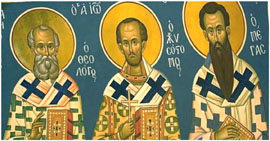
Feast day of the Three Hierarchs
Friday 30 January 2026
(†) Bishop Augοustinos Kantiotes
“Men of yearning… do not cease crying out to the Lord for us”
(doxasticon of the stichera, Small Vespers
Christianity, however, isn’t only a fine theory, it’s also superb practice; it’s not just illumined words, it’s also a great and important undertaking. And just as our Lord Jesus Christ practiced what He preached —i.e. He enforced it— in the same way the Church, which continues the work of the Lord, practices what it teaches.
Who puts it into practice? The Church’s
chosen children. And who are the chosen children? The saints. The saints
are champions of the spirit. And when we speak of saints, let’s
not just think of those who went to Katounakia on Mt. Athos and prayed
all night using the prayer rope, and made the mountain a radar field of
wireless communication, becoming united with the Eternal One. Without
doubt, they’re also saints, we don’t deny it. But according to the
Gospel, according to the spirit of the Gospel, the saints are also those
who remain here in the world, in the arena of life’s harsh struggles,
who believe in the Lord, strive, struggle and labour to do good, and who
rise unto holiness with the
grace of God. These are the saints.
Saints don’t come from just one class of people or one profession. Saintliness is the plant that thrives in every class of people.
Saints, as the synaxarion of the Orthodox Church proves, have stemmed
from all classes and all professions. Would you like me to mention some
specific examples? The patron saint of postmen, for example, is St.
Zenon; of farmers is St.Tryphon; of shepherds is St. Spyridon; of
carpenters is St. Joseph the Betrothed; of soldiers are the 40 Holy
Martyrs of Sebaste; of army officers are St. Demetri, St. George and
others. We even have patron saints for kings – St. Constantine and his
mother, Helen.
And for the learned, (those people who teach and study at the different
education centres of every level) who are the patron saints? These are
the saints that we celebrate today, the Three Hierarchs: St. Basil the
Great, St. Gregory Nazianzen (or St. Gregory the Theologian) and St.
John Chrysostom. This gives rise to the question: why did the Church and
our Greek race choose these saints as patron saints of education and
learning? The answer is in one of the hymns of their small vespers
service. The Church, referring to the Three Hierarchs, says “Men of
yearning… do not cease crying out to the Lord for us” (dox. Stich.).
Let’s analyse this phrase: what does men of yearning mean?
* * *
Each person, my beloved, has desires. God, who destined man for a lofty purpose, implanted his soul with lofty desires
and inclinations. The holy prophets such as Daniel were called Men of
desires (Dan. 9:23, 10:11) . What desires did they have? If you have
such holy desires, my brethren, my children, I will bow down and
prostrate before you. If you don’t have such holy desires, but you have
the desires of crows and vultures and beasts; an inferior level of
desires, then you are pitiful; you are no longer a human being, but an
animal that satisfies only its base impulses.
God has provided man with great and holy desires. In other words, I’d
say that he has three great yearnings. The first is the desire for
knowledge, the second is the desire for good works and the third is the
desire or yearning for virtue or holiness. Allow me to briefly analyze
these three desires, which burn in the hearts of
every person.
The first is the desire for knowledge. Even the ancient
philosophers said that it is in man’s nature to desire knowledge. This
desire is inbred. Take, for instance, a small child. As soon as it opens
its eyes and starts to understand things, when it’s 3 or 4 years old,
it’s all questions. It constantly asks, what is this? What is that? It
explores, to get to know the world. Its grandmother, mother, primary
school teacher, high-school teacher and later the wise university
lecturers, answer its questions. And when the youth is not satisfied by
this, it leaves its homeland, flies overseas and goes to renowned
universities where famous scientists teach. And does it eventually find
what it seeks? No. And then Socrates can finally provide him with the
answer, “One thing I know – that I don’t know anything.”
But no matter how much people study, the knowledge that they will
acquire —whether theological, scientific or philosophic— is but one drop
in the boundless ocean of knowledge.
The second desire, which I consider superior, is the desire for action.
To fill your head with data, to make it an encyclopaedia and to be a
bearer of knowledge isn’t enough. You need to put your knowledge into
practice; you need to use what you learn. Alexander the Great was of the
same mind. He didn’t want to simply learn wisdom from his teacher,
Aristotle; he wanted to
put into practice what he learned – to implement it.
And the third desire is the yearning for virtue, or holiness. This is
the most superior of all the desires. It leads a person to achieve his
goal of eternity, heavenly bliss. The desire for virtue makes a sinful
person realize his passions, his weaknesses and faults. It attracts him
to the light and to the pinnacle of purity. He chooses to muster his
abilities and with Christ’s help makes a huge effort to escape from the
traps of the base desires. Finally it grants him great wings, so that he
can reach the level which his soul desires.
* * *
The Three Hierarchs that we celebrate today, possessed those three desires, my beloved. This is why we rightly hymn them as men of yearning.
They had the desire for knowledge. They even studied
the secular works of the gentiles, who weren’t Christians. Back then,
only a few people knew the ancient classical authors like they did.
Studying them, they learnt the ancient language, rhetoric, forgeign
sciences – they acquired encyclopaedical knowledge. But more than
anything they deeply studied and learnt the Holy Scriptures by heart
—the Old and New Testament— as well as the Apostolic Fathers and the
Apologetic Fathers.
However they didn’t limit themselves to dry knowledge. Their Christian
love cultivated the desire to put what they learnt into practice. They
weren’t simply theoretical teachers; they wanted to put into practice what they had studied. They
were dynamic people. They defended the rights of the poor against the
almighty leaders and the wealthy; they protected the weak widows and
orphans, creating soup-kitchens for the hungry; they built hospitals,
sanitariums for lepers, nursing homes and orphanages in a time when
government welfare didn’t exist. They preached, they taught, they wrote,
they rushed to fulfill every need.
The Three Hierarchs, as true philosophers, had as their sole purpose in learning and studying, and in their daily actions, to imitate Christ – not to take advantage of people but to sacrifice themselves for them, to gain holiness and perfection.
And finally, speaking especially to the youth, I say: Imitate the Three
Hierarchs. Acquire a yearning for knowledge, study. If you seek to learn
for the sole purpose of becoming rich, that’s called fornication.
Obtain knowledge, but in addition, arm yourselves with love. Love Christian virtue, holiness.
Your homeland has a need of your knowledge your works, your virtuous way of life. Shine like the stars
in the dark firmament of the world. Out of your generation will arise
brilliant teachers, learned professors, incorrupt magistrates honourable
businessmen, pioneering scientists, courageous army officers, pious
priests, inspired hierarchs – whatever is eminent and holy will arise
out of your generation. And our country, having such offspring,
addresses you and says, “Rejoice, Greek youth, you men of yearning.”
Amen.
(†) Bishop Augoustinos

